
On Composer Study
The Homeschooling by Subject Series

Music has been an integral part of history since the beginning. From the psalms of David to your favorite Amazon playlists or Spotify stations today, every culture in every time period has used music for expression, pleasure, and even a high form of worship. Music clearly carries meaning.
Music tells us how to feel. While the words are often important, it is the notes being played that dictate what those words mean. And when you listen to music without words, there is no loss; the combination of notes can evoke joy or sadness, excitement or calm. Think of music in the background of a movie; we know suspense, fear, sentiment, or happiness based on the notes being played.
You are forming your child’s tastes in the pre-school and school years and what is being poured into his ears — and consequently, his soul —matters. It matters a great deal. And it stays with us for a long time. I bet every Xennial out there can sing the words to their favorite show’s theme song1, just like I can. As we talked about with memory work, remembering allows us to pass culture from one generation to the next.
What do you want your kids to be able to sing or hum when they have children of their own? Some of the music you introduce in your homeschool may stay with your kids their whole life.
What is the soundtrack of your home?
Of their childhood?
We’ve covered hymns and folk songs and today we’ll cover timeless, though wordless, music written by names that have carried on through the centuries. This is composer study.
Charlotte Mason believed it was important not to hear this music randomly, but to take time and get to know the style and music of each composer:
“Let the young people hear good music as often as possible, and that under instruction. It is a pity we like our music, as our pictures and our poetry, mixed, so that there are few opportunities of going through, as a listener, a course of the works of a single composer. But this is to be aimed at for the young people; let them study occasionally the works of a single great master until they have received some of his teaching, and know his style.”
Good music is not age-sensitive. The whole family will benefit from composer study and it’s an easy thing to lay in to your every day life. If you have never done composer study, I encourage you to consider it, no matter where you are at on your homeschooling journey.
Composer Study
Goal: to become familiar with the composer and enjoy his/her work
Composer study is meant to provide an immersive experience by focusing on one composer at a time, including the reading of a short biography. The hope is for the child to develop a relationship with the music and become familiar enough that he can recognize, “Oh, that’s Mozart!”
When you are starting out, try to choose the most popular composers first (Beethoven, Tchaikovsky, Mozart, Bach, Chopin), as they are foundational and inspirational for so many who came after them.
I align composer study with history when possible. Right now we are studying the 1800s so it’s a great time to immerse ourselves in Antonín Dvořák or Johannes Brahms.
I also align it with the seasons, if possible. I love to study Tchaikovsky in the winter, kicking off with The Nutcracker at Christmas and moving on to Swan Lake, 1812 Overture, and other classics over the season. Another example is to study Handel during the spring. Though Handel’s Messiah is now synonymous with the Christmas season, the Hallelujah chorus was originally conceived and intended for Easter.
What you choose to study will vary greatly by family. Pick something you like!
Remember: It’s nice to know a little about the composer, especially where he/she is from, the time period the composer was popular, and the names of some of their more famous (or favorite) pieces, but don’t lose sight of the goal. Your student should be familiar with some of the composers and enjoy listening to the music.
Time spent:
We usually spend about one term (12 weeks) on each composer.
We do composer study once a week.
Composer study should take about ten minutes each time.
Composer study works really well during Morning Time but can also just be done in the car (the listening part, anyway).
Planning:
Choose 1 composer per term.
I like to be mindful of the kids’ ages when choosing a composer. Some composers are perfect choices for young ones like, Camille Saint-Saëns with his Carnival of Animals and Sergei Prokofiev with his Peter and the Wolf. Listening to Wolfgang Amadeus Mozart, the child prodigy, may not actually produce the alleged “Mozart Effect” but his music is still pleasing to young ears. Don’t be afraid to follow your family’s interests here; every Star Wars or Harry Potter fan should study John Williams and every Peanuts fan should know Vince Guaraldi’s name.I started with my favorite composers because kids will enjoy what you are passionate about.
Usually we study a new composer each term but sometimes we’ll cover someone for a second time if a younger sibling was too young to remember the first time around.
I find a short, well-written biography on the composer and a collection of his best work on YouTube or Amazon Music (or Spotify if that’s you) and add it to our “Composer Study” playlist. I play it in the background as a way to review. I usually play it on Tuesday mornings as we are getting ready.
Day 1 - Every other day
I introduce the composer by reading a short biography a little each week until we complete it. I have them narrate back to me about the composer’s life.
We listen to a different piece by the composer each week. If our reading mentions a particular piece, that is what we’ll choose. If not, I go in order of his most popular pieces.
Exams
For exams, they hum their favorite piece, tell the name if they can, and tell a little about the composer. The goal is to do as much as they can and to celebrate what they remember.
Resources*
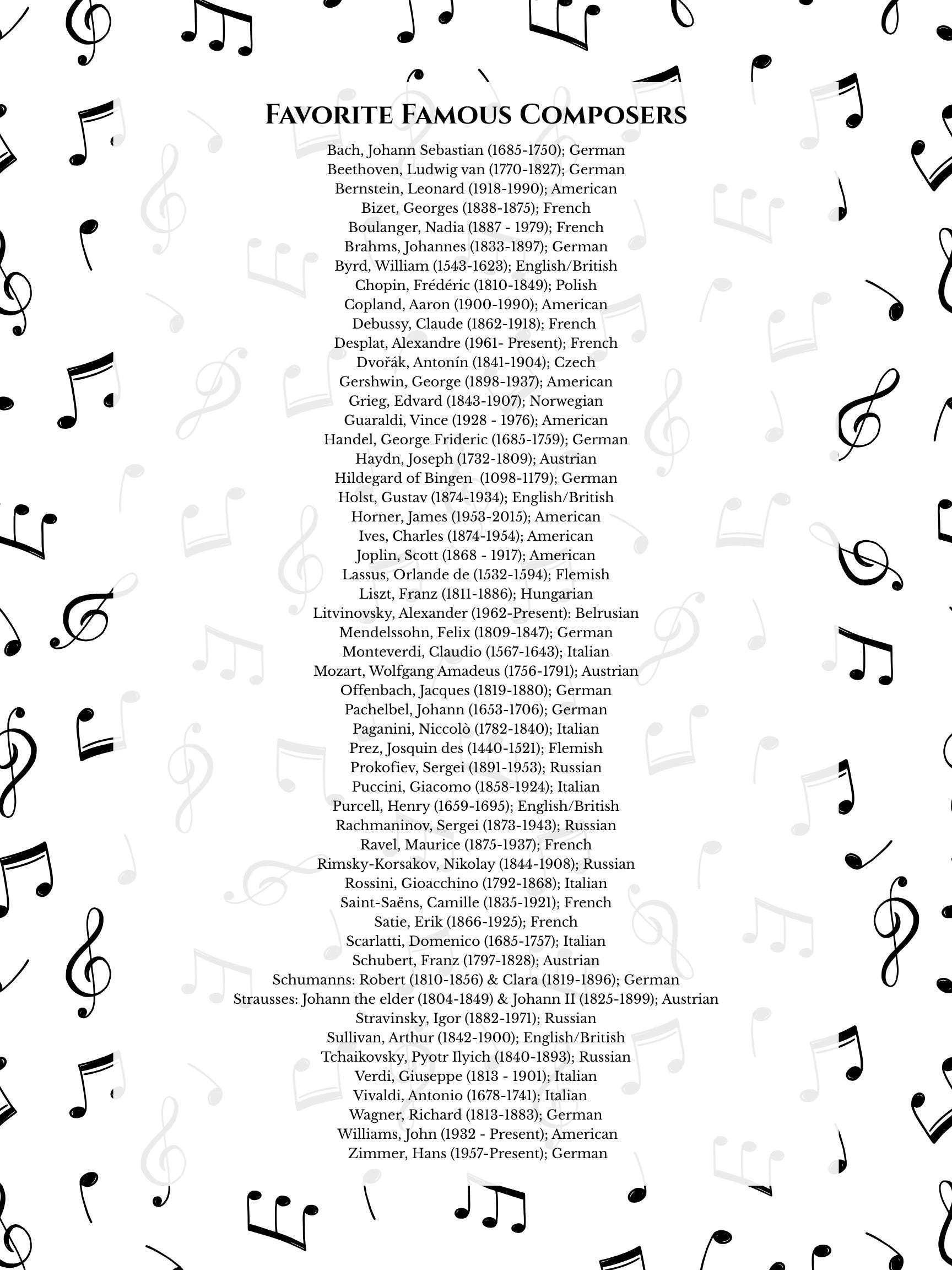
Composer Study Master List, compiled by yours truly. It’s organized alphabetically, chronologically, and by nationality. I’ve also included a suggested composer study schedule.
We fill out one of these for each composer and store them in a binder chronologically.
Ambleside Online: Composer Study
Spines:
The Great Composers by Wendy Thompson (good; a bit textbookish but comprehensive)
Lives of the Musicians: Good Times, Bad Times (and What the Neighbors Thought) by Kathleen Krull (better; funny details and caricature illustrations)
Great Composers: 18 Makers of Music by Warren S. Freeman (the best but hard to find; a true living book)
For littles and early elementary:
Baby Einsteins: There is a wonderful DVD called Meet the Orchestra that you can also find as a playlist on YouTube.
Little Einsteins: My youngest especially enjoyed the show. She also had a CD she loved that is discontinued but I found this and this on YouTube and I’m sure there are other playlists.
The Story of the Orchestra series is an interactive, artfully designed, storybook experience. Hopefully there will be more, but these are the current titles:
Four Seasons in One Day (Vivaldi)
Swan Lake (Tchaikovsky)
The Nutcracker (Tchaikovsky)
The Sleeping Beauty (Tchaikovsky)
Carnival of the Animals (Saint-Saëns)
In the Hall of the Mountain King (Grieg)
Shakespeare’s A Midsummer Night’s Dream (Mendelssohn)
The Magic Flute (Mozart)
The Planets (Holst)
Hansel and Gretel (Humperdinck)
The Beethoven’s Wig CDs shaped our homeschool in the pre-school and early elementary years and I can still remember the lyrics to many of the songs. This collection is a huge reason that my kids all love classical music and that they are familiar with so many composers. I cannot recommend these enough:
For early elementary and beyond:
Maestro Classics is a phenomenal resource. We especially love:
The Nutcracker (featuring Jim Weiss)
The Story of the Orchestra is a great book that goes through each section of the orchestra.
Meet the Orchestra is another good option.
Halidon Music is fantastic for older kids (or kids of any age). I especially love the super fun themes and images on their videos and I like to play it on our TV in the background throughout the day. Another big perk is that they list the name of the piece and the composer in the bottom banner. Here are a few favorite videos (although there are so, so many good ones to choose from!):
Classical Music When You’re on a Deadline (I may have written a few Substacks to this one ;))
Music for Reading (our staple rest time music)
Thank you for reading. I offer forever-free articles every month and a paid monthly resource, as well. You can become a subscriber to support my work.
*Till next time,
Cindy
*Many of the resources contain affiliate links. If you purchase an affiliate product, your price does not increase but I do get a tiny “thank you” portion from the company for recommending their products. I only have an affiliate relationship with products I use and love.
I love the scene from Inside Out where they eliminate useless long-term memories and send them to the dump. “The song from the gum commercial??” — they save it and it’s hilarious because it’s true. So often we remember things that are not really worth remembering and we struggle (more so as we get older) to hang on to the things we wish we could keep. I can tell you my third grade best friend’s home phone number. I can sing the entire theme song from The Fresh Prince of Belair. But how much scripture — especially long passages — can I say? How many poems can I recite? What about famous speeches? The answer, of course, is not nearly as much as I wish.