
On Memory Work
The Homeschooling by Subject Series

The phrase “memory work” is one that can carry baggage for people. The act of memorizing something may bring to mind a collection of facts you memorized as a child that you now deem useless such as the planets or the names of the bones in the body. You may think of learning scripture verses in exchange for candy or cramming gobs of information into your head the night before an exam. You may think of your phone number or address and yes, memory work can include these things, but the heart of memory work is a very different thing than mind-numbing memorization.
Andrew Pudewa from IEW said, “I cannot possibly overstate the value of memorizing good language as being fundamental to building excellent communication skills.” Memory work furnishes the mind; it becomes a part of the student’s thoughts and vocabulary. Memory work is important for brain training — the Greeks knew this — and being able to retrieve the information on our own with one quick Google search doesn’t replace the benefits of committing something to memory.123
Whenever I get push back from my kids about memory work I get a little dystopian and remind them that there may come a day or time or place where we cannot access these things with a quick search on our phones. Whether that is because the world has gone 1984 or simply because we’re waiting in a long line at the DMV and we have no cell service, it’s nice to have some worthwhile words stored in our mind palaces. I memorize worthwhile words for the same reason I collect books; the digital world may change but text is text and memory work is forever. In other words, they may take (or change) our resources, but they will never take the words hidden in our hearts.
A better way to think about memory work would be to consider it remembering. Cindy Rollins says it this way in Mere Motherhood:
“If we understand the difference between memorizing and remembrance then it will help us choose what to memorize. Remembrance is culture. It is all that has come before that makes us the kind of people we are.
This definition gives us a much fuller version of memory work. Some things like your social security number and the countless passwords required for our online existence are just good to remember because they make things easier in life. But when we are guiding our children in memory work, we must think of culture.
What is worth remembering?
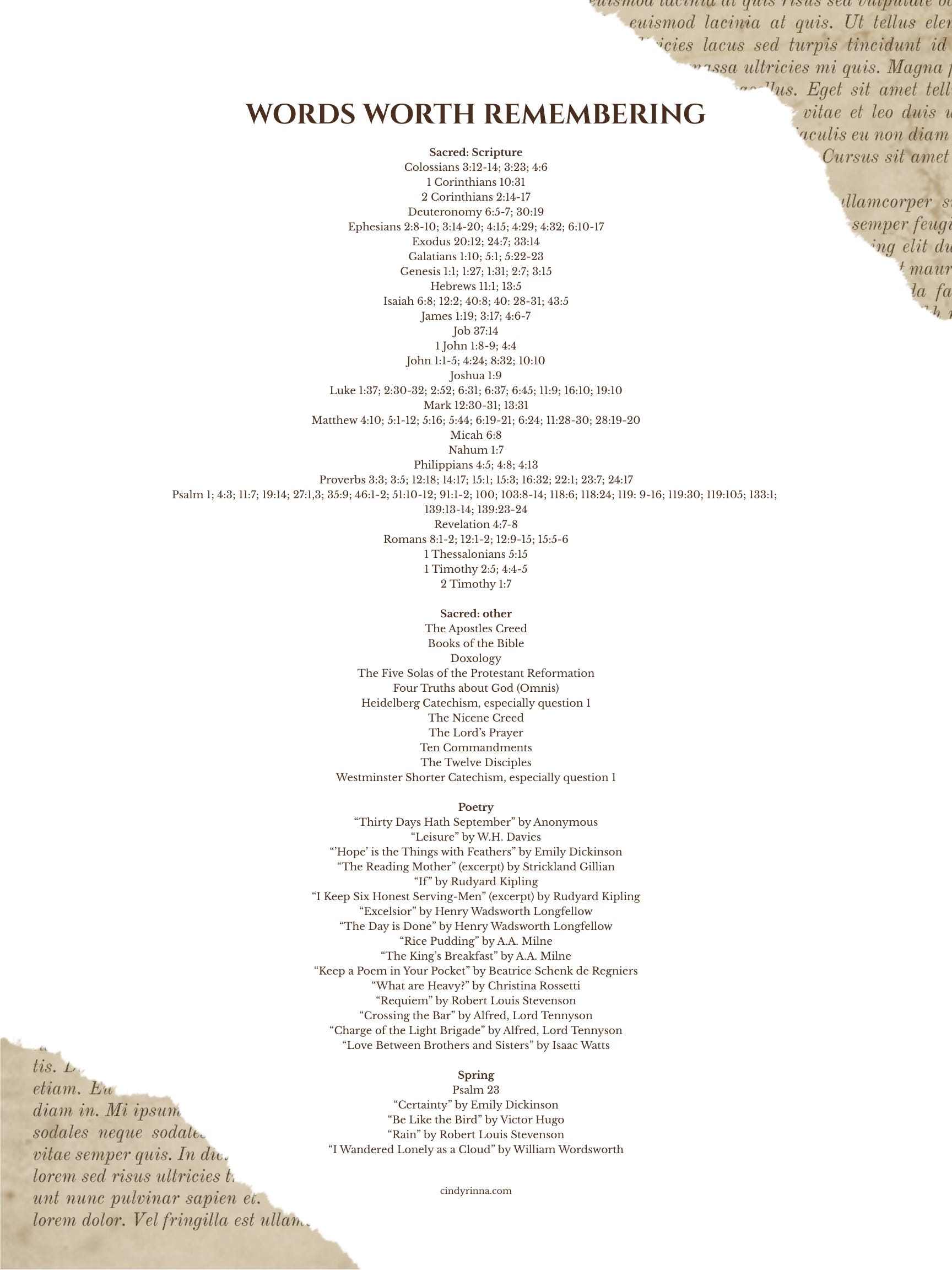
Scripture (as well as creeds & catechisms), poetry (including Shakespeare), speeches and documents, and songs are among the things we’ve deemed worth memorizing in our family. Most of my selections reflect the passion of the human race; they tell our story.
Sacred words are buried in our hearts to guide our steps, to help us fall in love with our Savior and seek to please Him, and to remind us of His truth, goodness, and beauty when we fall short. All throughout the Bible, God is telling His people to remember. His Word, of course, is the greatest thing we can remember. As Sally Clarkson says in The Lifegiving Home Experience, “remembering is an act of rooting ourselves deep in the soil of our spiritual heritage.”
Poetry helps create family culture and rhyming poetry is begging to be remembered, especially when it is funny or touching. It also gives us a glimpse into the past and hands culture down. Like I said last time, if you want to really experience a certain time period, you should consult the poets. But poetry is not the only way to carry history around in your head.
Speeches and Documents linked to important historical events help us walk through time. We can hear the words of those who have gone before us and honor their bravery, insight, and tact. Abraham Lincoln and Fredrick Douglas were seen as great orators and they both memorized excerpts from famous speeches.
Songs are made to be memorized. Like some of the best poetry, they rhyme making them particularly fun and easy to remember. Songs can be memorized for pure enjoyment or to pass a message from one generation to the next. Some are so catchy that you don’t even have to try that hard.
I love the scene from Inside Out where they eliminate useless long-term memories and send them to the dump. “The song from the gum commercial??” — they save it and it’s hilarious because it’s true. So often we remember things that are not really worth remembering and we struggle (more so as we get older) to hang on to the things we wish we could keep. I can tell you my third grade best friend’s home phone number. I can sing the entire theme song from The Fresh Prince of Belair. But how much scripture — especially long passages — can I say? How many poems can I recite? What about famous speeches? The answer, of course, is not nearly as much as I wish.
In The Lifegiving Home, Sarah Clarkson says, “To remember is not merely to recall past events. Rather to remember is to return to the vision of the world held by those who have gone before.”
Memory work allows us to pass culture from one generation to the next. We deem what is worth remembering, just as others have done before us, and we pack it lovingly into the treasure chest of our children’s hearts. In fact, another way to speak about memorizing is to say you’ve learned something “by heart.” Not by eye or by ear, mind you, but by heart. When we teach a child to memorize something we are sending a message: This is valuable. Store this. Hold tight to this. Remember this.
Memory Work
Goal: to memorize words worth remembering, namely scripture, creeds & catechism, poetry, passages from Shakespeare plays, speeches & historical documents, and other important information.
Each term we choose 1-2 scripture passages or sacred information (books of the Bible, apostles creed, Nicene creed, catechism questions/answer), a poem or speech, and a passage from the Shakespeare play we’re reading.
I align scripture memory with our bible reading. We’ve been reading through the book of Psalms together so I picked a verse to memorize from the Psalms we’re covering this term.
I align memory work with history when possible. Right now we are studying 1800s American History so it’s a great time to memorize the Gettysburg Address and “O Captain, My Captain.”
I also align it with the seasons. This works best with poetry and sometimes scripture. I’ve included some good Thanksgiving verses and poems in my November Everything guide.
When the kids were very young they memorized my and my husband’s phone numbers, our address, the days of the week, the months of the year, and other important information.
As I said earlier, memory work is not so much for retaining information as it is the act of hiding knowledge in your heart so academic memory work is minimal. Some exceptions are math facts, the planets, the states and capitals, the periodic table, and Classical Conversation’s timeline song. It’s fantastic and we still reference it all the time. We also memorized their presidents song.
What you choose to memorize will vary greatly by family. While it’s a good idea for every Christian to memorize the Great Commission and every American to know our national anthem, much of what you choose to have your family learn by heart will reflect the values, ideals, and culture of your unique family. Many of the poems we’ve memorized bring back a memory; I’ll never read “Rice Pudding” by A.A. Milne without thinking of my boys as young children reciting it to my then toddler daughter any time she fussed during morning time.
Time spent:
As long as it takes to memorize the passage. This could be a few days or a few weeks depending on the length and difficulty of the passage.
We practice memory work every school day.
Memory work should take 5-10 minutes a day.
Memory work fits really well into Morning Time but I have also done it in the car by playing songs or having them recite something I have already memorized.
Planning:
If this is your first time doing this, you’ll need to make a memory work notecard box or have some other type of organization system in place.
We use a notecard box based on the Scripture Memory system by Simply Charlotte Mason. The idea is that you are always learning a new passage while reviewing old passages. I divide my tabs a bit differently:Daily
Even
Odd
Monday
Tuesday
Wednesday
Thursday
Friday
Sacred
Poetry
Shakespeare
Autumn
Christmas
Winter
Spring
Summer
Other
Next
Each term, I choose new memory work:
2 Sacred passages
1 or 2 Poems
1 Shakespeare passage (if we’re currently reading a play)
Speech/Historical document excerpt if relevant or “other” as needed.
Consider asking students for input on what they would like to memorize. Memory work should be enjoyable for them and if they really hate a passage they are not going to memorize it. That said, if you have nine kids, you may just want to make an executive decision ;).
I hand write each of the passages on separate notecards. This helps me to memorize them, too.
I file the first passage we’re going to work on behind the daily tab. The rest go behind the “next” tab.
Day 1
I read the whole passage to them and then I have them write it for copywork. I usually just write it on a dry erase board for them to reference because we typically do morning time at the dining table. This could take a few days depending on the length of the passage. It is usually something they are already familiar with because of what we’re studying in other subjects but if they have no idea why they are memorizing it, you’ll want to explain why these words are worth remembering. Sometimes I’m fancy and write it for display on the chalkboard in our library, too, so they can see it at random points in their day and accidentally practice as they read it.
Every other day
I say the daily passage, they repeat it. I do one line at a time then once it becomes easy, add another line. Once we’ve been doing it for a while, I’ll sometimes have one kid say one line and go around the table. Sometimes if we’ve been learning a passage for a while I will read a few words and then pause, having them fill in the missing phrase. We do the daily passage all together but the goal is for each student to be able to recite the memory passage.
As for the review passages, I choose from the relevant tabs. I choose four tabs to review each day because I have four kids and we’ve been doing this since 2015 so we’ve got a lot of notecards. You can choose as many as you want. This is what my four look like:
Even or Odd (depending on date)
Monday, Tuesday, Wednesday, Thursday, or Friday (depending on day)
Sacred (this is our biggest tab so we review daily)
Poetry, Shakespeare, Autumn/Christmas/Winter/Spring/Summer (depending on season), or Other.
Once we review one of these tabs, I move it to the back and review the next one the next day. So, if on Monday we reviewed poetry, Tuesday we would review Shakespeare, Wednesday we would review Autumn (because it’s autumn), Thursday we would review Other, Friday we would review poetry again, and so on.
Each time we review a passage, I move it to the back of that tab.
If the kids can’t remember the review passage, I simply hand them the notecard and have them read it.
Once your family has memorized (or pretty much memorized) the daily passage, you move it forward to the “Even” tab, pushing everything else forward one tab. Once you run out of days of the week, file the notecard under whichever heading fits best: sacred, poetry, Shakespeare, Autumn, Christmas, Winter, Spring, Summer, or Other.
If you have a homeschool group consider doing a recitation day. This could be as simple as a monthly meet up where kids present something they’ve memorized or as elaborate as hosting a recitation night ala Anne of Green Gables. The point is to provide an opportunity for them to share what they’re memorizing in a meaningful way.
If you start incorporating memory work into your day when your kids are young, this will be easy. If you start when they’re older, you may get some push-back but be consistent and confident. This is worth it.
What if it doesn’t work? What if the passage doesn’t get memorized and every one is sick to death of hearing Washington’s farewell speech or “Excelsior?” Move on. That’s what’s so great about the memory box system. You will continue to practice the passage for years to come. and even if no one ever memorizes Macbeth’s whole soliloquy from Act 5, familiarity is better than nothing.
Exams
For exams, I ask them to recite each thing we’ve memorized. I don’t think anyone has ever been able to do this perfectly but that’s okay. The goal is to do as much as they can and to celebrate what they remember.
Resources*
Ambleside Online: Beginning in Year 1, the advisory gives recitation suggestions
Morning Time: A Liturgy of Love by Cindy Rollins
By Heart: The Goodness of Memory by Andrew Pudewa
IEW podcast: Poetry Memorization Through the Years
Sally Clarkson’s recommendation on what to memorize
Words Worth Remembering master list, compiled by yours truly
Receive my monthly recommendation of memory work by becoming a paid subscriber
*Many of my resources contain affiliate links. If you purchase an affiliate product, your price does not increase but I do get a tiny “thank you” portion from the company for recommending their products. I only have an affiliate relationship with products I use and love.
https://www.saidhasyim.com/post/peak-brain-plasticity/the-role-of-greek-philosophy-in-memory-understanding/
https://www.learningscientists.org/blog/2017/2/2-1
https://medium.com/@byronreese/ancient-greeks-and-memory-c44bcdcc0f08